How Did the Jesuits Influence the Art of the Qing Dynasty?


The history of the missions of the Jesuits in China is part of the history of relations betwixt China and the Western globe. The missionary efforts and other piece of work of the Society of Jesus, or Jesuits, betwixt the 16th and 17th century played a significant role in continuing the manual of knowledge, science, and culture between China and the West, and influenced Christian culture in Chinese society today.
The first try by the Jesuits to reach China was made in 1552 past St. Francis Xavier, Navarrese priest and missionary and founding fellow member of the Society of Jesus. Xavier never reached the mainland, dying afterward only a year on the Chinese island of Shangchuan. Three decades later, in 1582, Jesuits once again initiated mission piece of work in China, led by several figures including the Italian Matteo Ricci, introducing Western science, mathematics, astronomy, and visual arts to the Chinese imperial court, and carrying on pregnant inter-cultural and philosophical dialogue with Chinese scholars, particularly with representatives of Confucianism. At the time of their acme influence, members of the Jesuit delegation were considered some of the emperor's most valued and trusted advisors, holding prestigious posts in the imperial government.[ citation needed ] Many Chinese, including former Confucian scholars, adopted Christianity and became priests and members of the Society of Jesus.[ citation needed ]
According to research by David Eastward. Mungello, from 1552 (i.e., the expiry of St. Francis Xavier) to 1800, a total of 920 Jesuits participated in the People's republic of china mission, of whom 314 were Portuguese, and 130 were French.[2] In 1844 People's republic of china may accept had 240,000 Roman Catholics, but this number grew rapidly, and in 1901 the effigy reached 720,490.[3] Many Jesuit priests, both Western-born and Chinese, are cached in the cemetery located in what is now the Schoolhouse of the Beijing Municipal Committee.[4]
Jesuits in China [edit]
The arrival of Jesuits [edit]

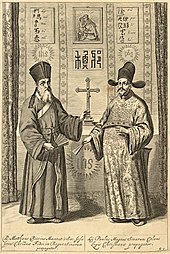
Contacts between Europe and the E already dated dorsum hundreds of years, particularly between the Papacy and the Mongol Empire in the 13th century. Numerous traders – most famously Marco Polo – had traveled between eastern and western Eurasia. Christianity was non new to the Mongols, as many had practiced Christianity of the Church of the Eastward since the 7th century (see Christianity amidst the Mongols). Withal, the overthrow of the Mongol-led Yuan dynasty past the Ming dynasty in 1368 resulted in a strong assimilatory pressure on China's Muslim, Jewish, and Christian communities, and not-Han influences were forced out of China. By the 16th century, there is no reliable data about whatsoever practicing Christians remaining in Mainland china.
Fairly soon subsequently the establishment of the direct European maritime contact with Red china (1513) and the creation of the Society of Jesus (1540), at to the lowest degree some Chinese became involved with the Jesuit endeavour. As early every bit 1546, two Chinese boys enrolled in the Jesuits' St. Paul's College in Goa, the capital of Portuguese Bharat. One of these ii Christian Chinese, known as Antonio, accompanied St. Francis Xavier, a co-founder of the Society of Jesus, when he decided to starting time missionary work in China. However, Xavier failed to find a way to enter the Chinese mainland, and died in 1552 on Shangchuan island off the coast of Guangdong,[v] the only place in China where Europeans were allowed to stay at the fourth dimension, only simply for seasonal merchandise.
A few years after Xavier'southward death, the Portuguese were allowed to establish Macau, a semi-permanent settlement on the mainland which was about 100 km closer to the Pearl River Delta than Shangchuan Island. A number of Jesuits visited the place (besides equally the main Chinese port in the region, Guangzhou) on occasion, and in 1563 the Lodge permanently established its settlement in the small Portuguese colony. Still, the early on Macau Jesuits did not learn Chinese, and their missionary work could reach only the very pocket-size number of Chinese people in Macau who spoke Portuguese.[half-dozen]
A new regional manager ("Visitor") of the order, Alessandro Valignano, on his visit to Macau in 1578–1579 realized that Jesuits weren't going to get far in Prc without a sound grounding in the language and culture of the land. He founded St. Paul Jesuit College (Macau) and requested the Order's superiors in Goa to send a suitably talented person to Macau to beginning the study of Chinese. Appropriately, in 1579 the Italian Michele Ruggieri (1543–1607) was sent to Macau, and in 1582 he was joined at his task past another Italian, Matteo Ricci (1552–1610).[6] Early efforts were aided by donations made by elites, and especially wealthy widows from Europe likewise Asia. Women such equally Isabel Reigota in Macau, Mercia Roiz in Ceylon (now Sri Lanka), and Candida Xu in China, all donated pregnant amounts towards establishing missions in China as well equally to other Asian states from People's republic of china.[seven]
Ricci'due south policy of accommodation [edit]
Both Ricci and Ruggieri were determined to adapt to the religious qualities of the Chinese: Ruggieri to the common people, in whom Buddhist and Taoist elements predominated, and Ricci to the educated classes, where Confucianism prevailed. Ricci, who arrived at the age of 30 and spent the rest of his life in China, wrote to the Jesuit houses in Europe and called for priests – men who would not only be "good", but too "men of talent, since we are dealing here with a people both intelligent and learned."[8] The Spaniard Diego de Pantoja and the Italian Sabatino de Ursis were some of these talented men who joined Ricci in his venture.
The Jesuits saw China every bit every bit sophisticated and generally treated China as equals with Europeans in both theory and practice.[ix] This Jesuit perspective influenced Leibniz in his cosmopolitan view of China as an equal culture with whom scientific exchanges was desirable.[10]
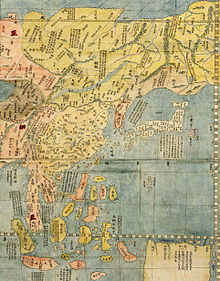
Map of the Far East in 1602, by Jesuit missionary Matteo Ricci (1552–1610)
Just as Ricci spent his life in China, others of his followers did the same. This level of commitment was necessitated by logistical reasons: Travel from Europe to Red china took many months, and sometimes years; and learning the land'southward language and culture was even more than time-consuming. When a Jesuit from China did travel back to Europe, he typically did it every bit a representative ("procurator") of the Prc Mission, entrusted with the task of recruiting more than Jesuit priests to come to China, ensuring connected support for the Mission from the Church'southward central authorities, and creating favorable publicity for the Mission and its policies by publishing both scholarly and pop literature about China and Jesuits.[11] One time the Chongzhen Emperor was nearly converted to Christianity and broke his idols.[12]
Dynastic alter [edit]
The fall of the Ming dynasty and the rise of the Manchu-led Qing dynasty brought some hard years for the Jesuits in China. While some Jesuit fathers managed to impress Qing commanders with a brandish of western science or ecclesiastical finery and to be politely invited to bring together the new order (equally did Johann Adam Schall von Bell in Beijing in 1644, or Martino Martini in Wenzhou ca. 1645–46),[xiii] others endured imprisonment and privations, as did Lodovico Buglio and Gabriel de Magalhães in Sichuan in 1647–48[xiv] [xv] or Alvaro Semedo in County in 1649. Subsequently, Johann Grueber was in Beijing between 1656 and 1661.

During the several years of war between the Qing and the Southern Ming dynasties, it was not uncommon for some Jesuits to discover themselves on dissimilar sides of the front lines: while Adam Schall was an important advisor of the Qing Shunzhi Emperor in Beijing, Michał Boym travelled from the jungles of south-western Mainland china to Rome, conveying the plea of help from the court of the Yongli Emperor of the Southern Ming, and returned with the Pope's response that promised prayer, subsequently some military assistance from Macau.[xvi] [17] [xviii] In that location were many Christians in the court of the polygamist emperor.
French Jesuits [edit]

A map of the 200-odd Jesuit churches and missions established across People's republic of china c. 1687.
In 1685, the French male monarch Louis Xiv sent a mission of five Jesuit "mathematicians" to Mainland china in an attempt to break the Portuguese predominance: Jean de Fontaney (1643–1710), Joachim Bouvet(1656–1730), Jean-François Gerbillon (1654–1707), Louis Le Comte (1655–1728) and Claude de Visdelou (1656–1737).[19]
French Jesuits played a crucial function in disseminating accurate information almost China in Europe.[20] A role of the French Jesuit mission in China lingered on for several years after the suppression of the Guild of Jesus until it was taken over by a group of Lazarists in 1785.[21]
Travel of Chinese Christians to Europe [edit]
Prior to the Jesuits, there had already been Chinese pilgrims who had fabricated the journeying due west, with 2 notable examples existence Rabban bar Sauma and his younger companion who became Patriarch Mar Yaballaha Three, in the 13th century.
While not too many 17th-century Jesuits ever went back from China to Europe, it was not uncommon for those who did to be accompanied by young Chinese Christians. Ane of the earliest Chinese travelers to Europe was Andreas Zheng (郑安德勒; Wade-Giles: Cheng An-te-lo), who was sent to Rome by the Yongli court forth with Michał Boym in the belatedly 1650s. Zheng and Boym stayed in Venice and Rome in 1652–55. Zheng worked with Boym on the transcription and translation of the Nestorian Monument, and returned to Asia with Boym, whom he cached when the Jesuit died well-nigh the Vietnam-China border.[22] A few years later, another Chinese traveller who was called Matthaeus Sina in Latin (not positively identified, but possibly the person who traveled from Red china to Europe overland with Johann Grueber) as well worked on the same Nestorian inscription. The result of their work was published by Athanasius Kircher in 1667 in the Prc Illustrata, and was the offset significant Chinese text e'er published in Europe.[23]
Amend known is the European trip of Shen Fo-tsung in 1684–1685, who was presented to male monarch Louis Xiv on September fifteen, 1684, and also met with rex James II,[24] becoming the beginning recorded instance of a Chinese man visiting U.k..[25] The king was and then delighted past this visit that he had his portrait fabricated hung in his own sleeping accommodation.[25] Afterward, another Chinese Jesuit Arcadio Huang would besides visit French republic, and was an early on pioneer in the teaching of the Chinese linguistic communication in France, in 1715.
Scientific exchange [edit]

Telling China about Europe [edit]
The Jesuits introduced to China Western scientific discipline and mathematics which was undergoing its own revolution. "Jesuits were accepted in tardily Ming court circles as foreign literati, regarded as impressive especially for their knowledge of astronomy, calendar-making, mathematics, hydraulics, and geography."[26] In 1627, the Jesuit Johann Schreck produced the first volume to present Western mechanical noesis to a Chinese audition, Diagrams and explanations of the wonderful machines of the Far Due west.[27] This influence worked in both directions:
[The Jesuits] made efforts to translate western mathematical and astronomical works into Chinese and aroused the interest of Chinese scholars in these sciences. They made very all-encompassing astronomical observation and carried out the start modern cartographic work in China. They also learned to capeesh the scientific achievements of this ancient civilization and fabricated them known in Europe. Through their correspondence European scientists showtime learned about the Chinese science and culture.[28]
Jan Mikołaj Smogulecki (1610–1656) is credited with introducing logarithms to China, while Sabatino de Ursis (1575–1620) worked with Matteo Ricci on the Chinese translation of Euclid'due south Elements, published books in Chinese on Western hydraulics, and by predicting an eclipse which Chinese astronomers had not anticipated, opened the door to the reworking of the Chinese calendar using Western calculation techniques.
This influence spread to Korea likewise, with João Rodrigues providing the Korean mandarin Jeong Duwon astronomical, mathematical, and religious works in the early 1630s which he carried back to Seoul from Dengzhou and Beijing, prompting local controversy and word decades before the first foreign scholars were permitted to enter the state. Like the Chinese, the Koreans were most interested in practical applied science with martial applications (such as Rodrigues's telescope) and the possibility of improving the agenda with its associated religious festivals.

Johann Adam Schall (1591–1666), a German Jesuit missionary to People's republic of china, organized successful missionary work and became the trusted advisor of the Shunzhi Emperor of the Qing Dynasty. He was created a mandarin and held an of import mail service in connection with the mathematical school, contributing to astronomical studies and the evolution of the Chinese calendar. Thanks to Schall, the motions of both the sun and moon began to exist calculated with sinusoids in the 1645 Shíxiàn calendar (時憲書, Book of the Conformity of Time). His position enabled him to procure from the emperor permission for the Jesuits to build churches and to preach throughout the country. The Shunzhi Emperor, withal, died in 1661, and Schall's circumstances at once changed. He was imprisoned and condemned to slow slicing death. After an earthquake and the dowager's objection the sentence was not carried out, but he died after his release owing to the privations he had endured. A collection of his manuscripts remains and was deposited in the Vatican Library. Subsequently he and Ferdinand Verbiest won the tests confronting Chinese and Islamic agenda scholars, the court adjusted the western calendar only.[29] [30]
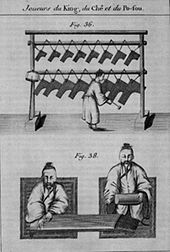
A page from Mémoires concernant l'histoire, les sciences et les arts des Chinois, 1780.
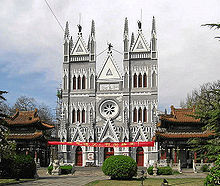
The Jesuits also endeavoured to build churches and demonstrate Western architectural styles. In 1605, they established the Nantang (Southern) Church and in 1655 the Dongtang (Eastern) Church. In 1703 they established the Beitang (Northern) Church well-nigh Zhongnanhai (contrary the former Beijing Library), on land given to the Jesuits by the Kangxi Emperor of the Qing Dynasty in 1694, post-obit his recovery from illness thanks to medical expertise of Fathers Jean-François Gerbillon and Joachim Bouvet.[31]
Latin spoken by the Jesuits was used to mediate between the Qing and Russia.[32] A Latin copy of the Treaty of Nerchinsk was written by Jesuits. Latin was one of the things which were taught by the Jesuits.[33] [34] A school was established by them for this purpose.[35] [36] A diplomatic delegation constitute a local who equanimous a letter in fluent Latin.[37] [38]
Telling Europe about China [edit]

Confucius, Philosopher of the Chinese, or, Chinese Knowledge Explained in Latin, an introduction to Chinese history and philosophy published at Paris in 1687 past a squad of Jesuits working under Philippe Couplet.
The Jesuits were besides very active in transmitting Chinese knowledge to Europe, such as translating Confucius'southward works into European languages. Ricci in his De Christiana expeditione apud Sinas had already started to written report on the thoughts of Confucius; he (and, earlier, Michele Ruggieri) made attempts at translating the 4 Books, the standard introduction into the Confucian canon. The work on the Confucian classics by several generations of Jesuits culminated with Fathers Philippe Couplet, Prospero Intorcetta, Christian Herdtrich, and François de Rougemont publishing Confucius Sinarum Philosophus ("Confucius, the Philosopher of the Chinese") in Paris in 1687. The book contained an annotated Latin translation of three of the Four Books and a biography of Confucius.[39] It is thought that such works had considerable importance on European thinkers of the period, particularly those who were interested in the integration of the Confucian system of morality into Christianity.[xl] [41]
Since the mid-17th century, detailed Jesuit accounts of the Viii trigrams and the Yin/Yang principles[42] appeared in Europe, quickly drawing the attending of European philosophers such equally Leibniz.
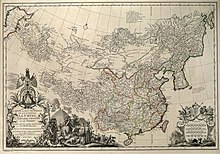
The 1734 map compiled by d'Anville based on the Jesuits' geographic research during the early 1700s
Chinese linguistics, sciences, and technologies were too reported to the West by Jesuits. Smoothen Michal Boym authored the first published Chinese dictionaries for European languages, both of which were published posthumously: the first, a Chinese–Latin lexicon, was published in 1667, and the second, a Chinese–French dictionary, was published in 1670. The Portuguese Jesuit João Rodrigues, previously the personal translator of the Japanese leaders Hideyoshi Toyotomi and Tokugawa Ieyasu, published a terser and clearer edition of his Japanese grammer from Macao in 1620. The French Jesuit Joseph-Marie Amiot wrote a Manchu dictionary Dictionnaire tatare-mantchou-français (Paris, 1789), a work of great value, the language having been previously quite unknown in Europe. He besides wrote a 15-volume Memoirs regarding the history, sciences, and art of the Chinese, published in Paris in 1776–1791 (Mémoires concernant 50'histoire, les sciences et les arts des Chinois, 15 volumes, Paris, 1776–1791). His Vie de Confucius, the twelfth volume of that collection, was more complete and accurate than any predecessors.
Rodrigues and other Jesuits besides began compiling geographical data about the Chinese Empire. In the early years of the 18th century, Jesuit cartographers travelled throughout the land, performing astronomical observations to verify or determine the latitude and longitude relative to Beijing of various locations, and then drew maps based on their findings. Their work was summarized in a 4-book Description géographique, historique, chronologique, politique et physique de l'empire de la Chine et de la Tartarie chinoise published past Jean-Baptiste Du Halde in Paris in 1735, and on a map compiled past Jean Baptiste Bourguignon d'Anville (published 1734).[43]
To disseminate information near devotional, educational and scientific subjects, several missions in Communist china established printing presses: for example, the Imprimerie de la Mission Catholique (Sienhsien), established in 1874.
Chinese Rites controversy [edit]
In the early 18th century, a dispute within the Catholic Church arose over whether Chinese folk religion rituals and offerings to the emperor constituted paganism or idolatry. This tension led to what became known as the "Rites Controversy," a bitter struggle that bankrupt out after Ricci's decease and lasted for over a hundred years.
At commencement the focal point of dissension was the Jesuit Ricci's contention that the ceremonial rites of Confucianism and ancestor veneration were primarily social and political in nature and could exist adept past converts. The Dominicans, even so, charged that the practices were idolatrous, meaning that all acts of respect to the sage and one'southward ancestors were nix less than the worship of demons. A Dominican carried the case to Rome where it dragged on and on, largely because no one in the Vatican knew Chinese culture sufficiently to provide the pope with a ruling. Naturally, the Jesuits appealed to the Chinese emperor, who endorsed Ricci'due south position. Understandably, the emperor was confused as to why missionaries were attacking missionaries in his upper-case letter and asking him to cull one side over the other, when he might very well accept simply ordered the expulsion of all of them.
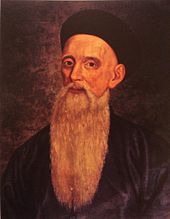
The timely discovery of the Nestorian monument in 1623 enabled the Jesuits to strengthen their position with the courtroom by answering an objection the Chinese often expressed – that Christianity was a new faith. The Jesuits could at present point to concrete prove that a thousand years before the Christian gospel had been proclaimed in China; it was not a new only an erstwhile faith. The emperor then decided to miscarry all missionaries who failed to back up Ricci's position.
The Castilian Franciscans, still, did not retreat without further struggle. Somewhen they persuaded Pope Clement Eleven that the Jesuits were making dangerous accommodations to Chinese sensibilities. In 1704 Rome decided against the aboriginal use of the words Shang Di (supreme emperor) and Tian (heaven) for God. Over again, the Jesuits appealed this decision.

Among the concluding Jesuits to work at the Chinese court were Louis Antoine de Poirot (1735–1813) and Giuseppe Panzi (1734-before 1812) who worked for the Qianlong Emperor as painters and translators.[44] [ failed verification ] [45] From the 19th century, the role of the Jesuits in People's republic of china was largely taken over past the Paris Foreign Missions Guild.
See also [edit]


- Protestant missions in China
- Ruins of Saint Paul's, Macau
- Cathedral of the Immaculate Conception (Hangzhou)
- People's republic of china and the Christian Impact, translation of Jacques Gernet's Chine et christianisme of 1982
- Cornelius Wessels
- Figurism
- China–French republic relations
- History of the Jews in China
- Listing of Cosmic missionaries to China
- Medical missions in Prc
- Catholic Church in China
- Listing of Protestant theological seminaries in China
- Three Pillars of Chinese Catholicism
References [edit]
Citations [edit]
- ^ Wigal, p.202
- ^ Mungello (2005), p. 37. Since Italians, Spaniards, Germans, Belgians, and Poles participated in missions also, the total of 920 probably merely counts European Jesuits, and does non include Chinese members of the Society of Jesus.
- ^ Kenneth Scott, Christian Missions in China, p.83.
- ^ Article on the Jesuit cemetery in Beijing by journalist Ron Gluckman
- ^ Ruggieri, Ricci & Witek 2001, p. 151 harvnb error: no target: CITEREFRuggieriRicciWitek2001 (help)
- ^ a b Ruggieri, Ricci & Witek 2001, p. 153 harvnb error: no target: CITEREFRuggieriRicciWitek2001 (help)
- ^ Zupanov, Ines G. (2019-05-fifteen). The Oxford Handbook of the Jesuits. Oxford Academy Press. ISBN978-0-19-092498-0.
- ^ George H. Dunne, Generation of Giants, p.28
- ^ Georg Wiessala (2014). European Studies in Asia: Contours of a Subject area. Routledge. p. 57. ISBN978-1136171611.
- ^ Michel Delon (2013). Encyclopedia of the Enlightenment. Routledge. p. 331. ISBN978-1135959982.
- ^ Mungello (1989), p. 49
- ^ "泰山"九莲菩萨"和"智上菩萨"考". Archived from the original on 2011-07-sixteen. Retrieved 2010-08-10 .
- ^ Mungello (1989), p. 106-107
- ^ 清代中叶四川天主教传播方式之认识 [ permanent expressionless link ]
- ^ Mungello (1989), p. 91
- ^ 南明永曆朝廷與天主教
- ^ 中西文化交流与西方早期汉学的兴起
- ^ Mungello (1989), p. 139
- ^ Eastern Magnificence and European Ingenuity: Clocks of Late Royal People's republic of china – Page 182 by Catherine Pagani (2001) Google Books
- ^ Lach, Donald F. (June 1942). "China and the Era of the Enlightenment". The Periodical of Modern History. Academy of Chicago Press. xiv (2): 211. doi:10.1086/236611. JSTOR 1871252. S2CID 144224740.
- ^ "Yearbook of the Society of Jesus 2014" (PDF), Jesuits, p. 14
- ^ Mungello (1989), p. 139-140, 167
- ^ Mungello (1989), p. 167
- ^ Keevak, p.38
- ^ a b BBC
- ^ Patricia Buckley Ebrey, p 212
- ^ Ricci roundtable Archived 2011-06-15 at the Wayback Machine
- ^ Agustín Udías, p 53; quoted by Woods
- ^ 第八章 第二次教难前后
- ^ 志二十
- ^ Shenwen Li, p.235
- ^ Peter C Perdue (30 June 2009). China Marches West: The Qing Conquest of Central Eurasia. Harvard Academy Printing. pp. 167–. ISBN978-0-674-04202-5.
- ^ Susan Naquin (2000). Peking: Temples and Urban center Life, 1400-1900. University of California Press. pp. 577–. ISBN978-0-520-21991-5.
- ^ Eva Tsoi Hung Hung; Judy Wakabayashi (16 July 2014). Asian Translation Traditions. Routledge. pp. 76–. ISBN978-1-317-64048-6.
- ^ Frank Kraushaar (2010). Eastwards: Western Views on Due east Asian Culture. Peter Lang. pp. 96–. ISBN978-3-0343-0040-7.
- ^ Eric Widmer (1976). The Russian Ecclesiastical Mission in Peking During the Eighteenth Century. Harvard Univ Asia Center. pp. 110–. ISBN978-0-674-78129-0.
- ^ Egor Fedorovich Timkovskii (1827). Travels of the Russian mission through Mongolia to China, with corrections and notes by J. von Klaproth [tr. by H.Eastward. Lloyd]. pp. 29–.
- ^ Egor Fedorovich Timkovskiĭ; Hannibal Evans Lloyd; Julius Heinrich Klaproth; Julius von Klaproth (1827). Travels of the Russian mission through Mongolia to China: and residence in Pekin, in the years 1820-1821. Longman, Rees, Orme, Brown, and Greenish. pp. 29–.
- ^ John Parker, Windows into Communist china: the Jesuits and their books, 1580–1730. Boston: Trustees of the Public Library of the City of Boston, 1978. p.25. ISBN 0-89073-050-4
- ^ John Parker, Windows into Cathay, p. 25.
- ^ John Hobson, The Eastern origins of Western Civilization, pp. 194–195. ISBN 0-521-54724-5
- ^ See due east.g. Martino Martini's detailed account in Martini Martinii Sinicae historiae decas prima : res a gentis origine advertizing Christum natum in extrema Asia, sive magno Sinarum imperio gestas complexa, 1659, p. 15 sq.
- ^ Du Halde, Jean-Baptiste (1735). Description géographique, historique, chronologique, politique et physique de l'empire de la Chine et de la Tartarie chinoise. Vol. Iv. Paris: P.Grand. Lemercier. There are numerous later on editions every bit well, in French and English
- ^ Swerts, p.18
- ^ Batalden, p.151
Bibliography [edit]
- Batalden, Stephen K., Kathleen Cann, John Dean. (2004) Sowing the give-and-take: the cultural bear on of the British and Strange Bible Order, 1804–2004. Sheffield Phoenix Press. ISBN one-905048-08-4 ISBN 9781905048083.
- Ebrey, Patricia Buckley. (1996). The Cambridge Illustrated History of Cathay. Cambridge, New York and Melbourne: Cambridge University Press. ISBN 0-521-43519-six.
- Mungello, David East. (1989). Curious Land: Jesuit Adaptation and the Origins of Sinology. University of Hawaii Press. ISBN0-8248-1219-0.
- Mungello, David E. (2005). The Dandy Come across of China and the West, 1500–1800. Rowman & Littlefield. ISBN0-7425-3815-X.
- Ricci, Michele; Ruggieri, Matteo; Witek, John W. (2001), Dicionário Português-Chinês : 葡漢詞典 (Pu-Han Cidian) : Portuguese-Chinese lexicon, Biblioteca Nacional, pp. 151–157, ISBN972-565-298-three (Detailed account of the early on years of the mission).
- Swerts, Lorry, Mon Van Genechten, Koen De Ridder. (2002). Monday Van Genechten (1903–1974): Flemish Missionary and Chinese Painter : Inculturation of Chinese Christian Art. Leuven University Press. ISBN 90-5867-222-0 ISBN 9789058672223.
- Udías, Agustín. (2003). Searching the Heavens and the World: The History of Jesuit Observatories. Dordrecht, The Netherlands: Kluwer Academic Publishers.
- Wigal, Donald. (2000). Celebrated Maritime Maps. New York: Parkstone Press. ISBN i-85995-750-1.
- Woods, Thomas, (2005). How the Catholic Church Built Western Civilization. Washington, DC: Regenery. ISBN 0-89526-038-7.
reyesforeseenothe.blogspot.com
Source: https://en.wikipedia.org/wiki/Jesuit_China_missions
0 Response to "How Did the Jesuits Influence the Art of the Qing Dynasty?"
Enregistrer un commentaire